Quick answer: With custom logo branding in Dubai, the material decides the method, not preference. Metal and bamboo take laser engraving, fabric takes embroidery or screen printing, plastic and coated surfaces take pad or UV printing, and anything curved rules out flat printing entirely. Choose the product first, then let the surface tell you how it can be branded.
Most branding disappointments start at the same point. Someone approves a logo on screen, the factory applies it to the wrong surface by the wrong method, and the item arrives looking thinner, duller or blurrier than anyone expected. In fact, nothing went wrong in production. The method simply never suited the material.
This guide covers the branding methods in common use across the UAE, what each one does well, which products they belong on, and how to supply artwork that survives the process.
Technique names vary between suppliers. Some quotes call pad printing tampo printing, sell debossing as blind embossing, or list UV printing as digital direct printing. However, the processes stay the same whatever the label says.
The Methods, Compared
| Method | Suits | Colour | Durability | Relative speed | Relative cost |
| Laser engraving | Metal, bamboo, wood, leather, glass | None — burns or etches the surface | Permanent, cannot wear off | Fastest | Low to medium |
| Pad printing | Curved and irregular plastic, pens, small items | One to four spot colours | Good, can scuff over years | Fast | Low |
| Screen printing | Flat fabric, bags, flat plastic and card | One to six spot colours, vivid | Very good on fabric | Fast at volume, slower in small runs | Low at volume |
| Embroidery | Polo shirts, caps, jackets, heavy fabric | Thread colours, limited fine detail | Longest-lasting on apparel | Slowest | Medium to high |
| UV digital printing | Flat or gently curved rigid surfaces | Full colour, photographic | Good indoors, can fade in strong sun | Fast | Medium |
| Debossing and embossing | Leather, faux leather, card, PU covers | None — pressed into the surface | Permanent | Medium | Medium |
| Sublimation | Polyester fabric, coated mugs and panels | Full colour, edge to edge | Excellent, dyed into the material | Medium | Medium |
| Doming (epoxy resin) | Badges, keyrings, small flat labels | Full colour under a raised lens | Very good, slightly raised finish | Medium | Medium |
What the Table Cannot Show You
A few things the table cannot quite convey.
Engraving has no colour, and that is often the point. On stainless steel or bamboo it produces a tonal mark in the material itself — understated, permanent, and generally read as the most premium finish available. If a brand’s identity depends on an exact colour, engraving is the wrong choice. If it depends on looking expensive, it is usually the right one.
Embroidery has a resolution floor. Thread cannot render fine lines, small text or tight gradients. Therefore a logo with a thin typeface or a detailed crest needs simplifying before anyone can stitch it, and that simplification is a design decision worth making deliberately rather than leaving to the machine operator.
Screen printing economics are about setup, not units. Each colour needs its own screen, so a four-colour logo costs four setups whether the run is fifty pieces or five thousand. Small orders in full colour are usually better served by UV printing.
Sublimation only works on polyester and specially coated surfaces. It cannot touch cotton or uncoated metal. When it does apply, though, the result is exceptional, because the image becomes part of the material rather than sitting on top of it.
Matching the Method to the Product
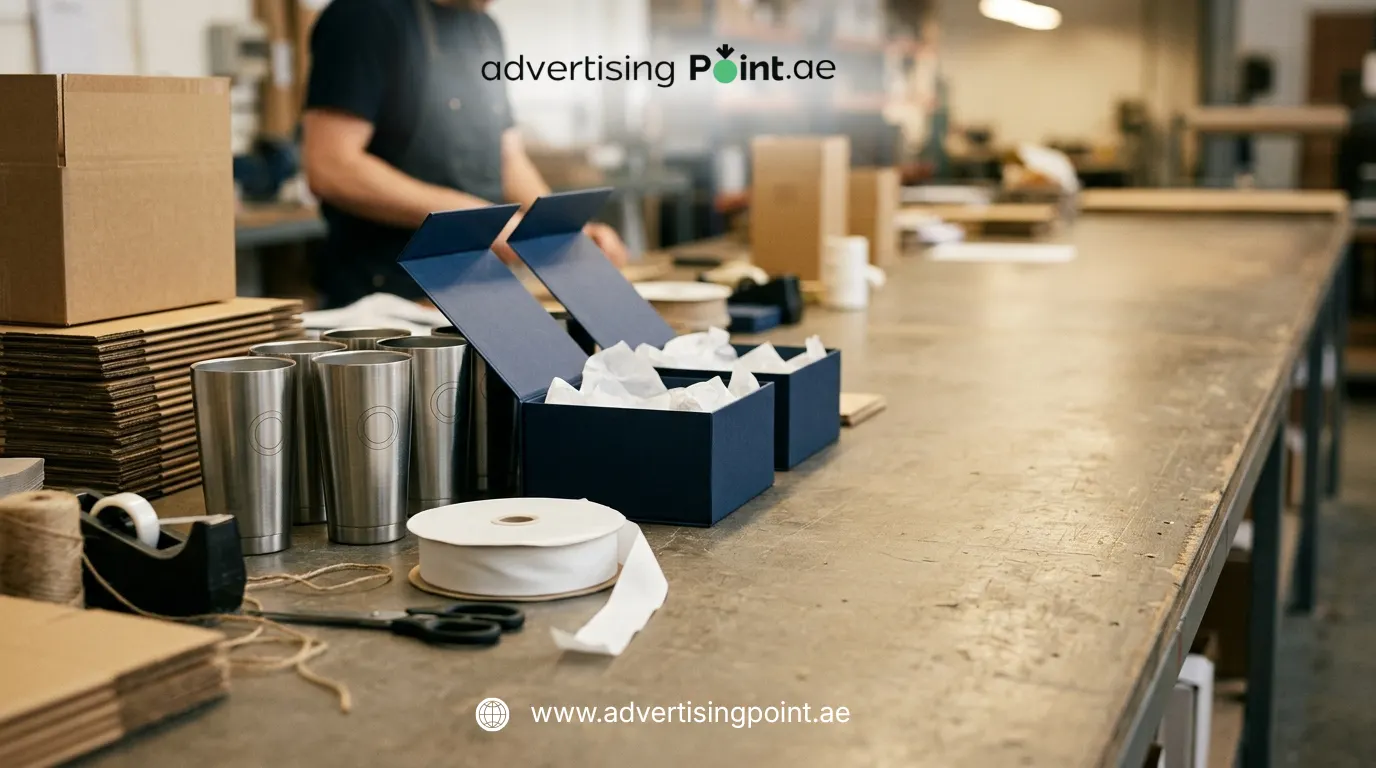
Drinkware. Almost every supplier laser engraves stainless steel tumblers and bottles, because engraving survives dishwashers, daily handling and years of use, none of which printing reliably does. On powder-coated bottles, the laser cuts through the coating to reveal the steel beneath, which produces a two-tone effect at no extra cost. Ceramic mugs take sublimation or pad printing instead. Browse custom tumblers to see how engraving sits on different finishes.
Apparel. Embroidery for polo shirts, caps and jackets; screen printing for t-shirts and anything with a large or multi-colour design. Position and size usually decide between them: a small chest logo suits embroidery, while a large back print suits screen printing. Embroidered polo shirts remain the default for staff uniforms because stitching outlasts the garment.
Notebooks and leather goods. Debossing on PU and leather covers, screen or UV printing on card and fabric covers. Debossing is the quieter, more expensive-looking option and has the advantage of never peeling.
Tech accessories. Power banks, chargers and USB drives usually take pad printing or UV printing, depending on how curved the surface is. Bamboo-bodied tech takes engraving instead, which is part of why it photographs so well.
Bags and totes. Screen printing for cotton and canvas, heat transfer or sublimation for polyester. Large designs are cheaper here than almost anywhere else because the surface is flat and forgiving.
Metal items and awards. Engraving, every time. Pens, keyrings, card holders and desk pieces all hold a fine engraved mark, and it remains the one finish that genuinely never degrades.
Supplying Artwork That Survives the Process
More branding problems originate in the artwork file than in the machine.
Send vector, not pixels. An AI, EPS, PDF or SVG file scales to any size without losing definition. A JPEG or PNG pulled from a website, by contrast, stays fixed at its original resolution, so enlarging it to fit a bag produces soft, ragged edges. If the only logo file you hold is a low-resolution image, someone needs to redraw it before it goes onto anything.
Check the logo at the size it will actually appear. A logo designed for a letterhead is usually being reduced to thirty or forty millimetres on a pen or a notebook. Print it at that size on paper and look at it. Thin strokes close up, small text fills in, and a tagline under the mark frequently becomes an illegible grey smudge. Most logos need a simplified version for small applications, and it is worth having one prepared once rather than improvising per order.
Colour, and Why It Shifts
Decide between spot colour and full colour early. Spot colours are mixed to a specific reference and reproduce consistently across runs; full-colour printing builds the image from four process inks and shifts slightly between materials. For brand colours that must match exactly, specify a Pantone reference rather than describing the shade.
Expect colour to behave differently by material. For example, the same reference prints brighter on white polyester than on natural cotton, and darker on matte surfaces than on gloss. Engraving, by contrast, ignores colour entirely and gives back whatever tone the material has. This is therefore the single strongest argument for approving a physical sample rather than a screen proof.
Supply the single-colour version too. Many methods can only apply one colour. So if your logo exists only in full colour, somebody will convert it, and it is better that the somebody is you.
What Makes a Branded Order Fast or Slow
Three things decide lead time, and only one of them is the branding itself.
Whether the product is in stock locally. This is the largest variable by far. An item already held in Dubai can move to branding immediately. An item being imported adds shipping and customs regardless of how quick the branding is, and no amount of urgency compresses that.
The method. Laser engraving and pad printing set up quickly and run quickly. Screen printing needs a screen per colour. Embroidery, meanwhile, needs someone to digitise the logo into a stitch file before the machine can sew a single garment — a one-off step, but a real one. So ordering the embroidered items first and the engraved items later is almost always the right sequencing.
Approval speed on your side. Artwork sitting in an inbox awaiting sign-off is the most common hidden delay in the whole process, and the one nobody records.
Where a supplier already holds the stock and the branding is straightforward, turnaround on ready-stock items can run as short as twenty-four to forty-eight hours, and genuinely urgent same-day requirements can sometimes work. That depends on the supplier handling branding in-house rather than subcontracting it. Because an outsourced branding step adds a transfer, a queue and a second quality check to every order, quoted lead times vary widely between suppliers for identical products.
The practical consequence: ask where the stock sits and who does the branding before you ask how long it takes. The answer to the third question follows from the first two.
The Errors That Cost a Reorder
Approving a screen mockup and nothing else. A digital mockup confirms placement, size and proportion. It cannot show you how a colour behaves on a matte surface or how thick embroidery thread renders a thin letterform. For a first order, or any order of real volume, approve something physical.
Branding too large. The most frequent aesthetic mistake, and it almost always comes from the client rather than the supplier. A logo that dominates the product turns a gift into merchandise, and merchandise ends up in a drawer. Restraint, by contrast, reads as confidence.
Using the full-colour logo everywhere by default. On a dark tumbler, a white single-colour version of the same mark will look sharper and cost less than a four-colour reproduction fighting the background.
Ignoring the branding area. Every product has a usable print area, and it is rarely the shape of your logo. A wide horizontal logo on a narrow vertical panel gets reduced until it is unreadable. Check dimensions before falling for the product.
Mixing methods across one order without checking. The same logo engraved on steel, embroidered on cotton and printed on a notebook will not look identical, because the materials do not permit it. Review the set together rather than item by item.
Leaving the artwork until the order is placed. Logo files, Pantone references and the simplified small-size version should exist before you start choosing products. Assembling them under deadline pressure is where the compromises creep in.
Choosing in Practice
The decision is simpler than the options suggest. Pick the product that suits the recipient, ask which methods its surface accepts, and choose between them on how long the item needs to last.
For anything intended to be kept and used for years — drinkware, desk pieces, metal items — choose the permanent finish, which usually means engraving or debossing. For items with a shorter working life, or where the colour is the whole point, printing is the sensible choice and costs less.
Two steps are worth insisting on regardless of method. Get a digital mockup before you commit to the order, which costs nothing and catches proportion and placement problems immediately. Then see a physical sample before a large run, because it is the only way to know how the colour and finish actually behave on that material.
A supplier who brands in-house can usually turn both of those around quickly, and can adjust between them without renegotiating with a third party. If you are weighing up branded corporate gifts in Dubai for a first order, that combination — mockup, sample, then production — is what separates an order you reuse next year from one you quietly replace.
Frequently Asked Questions
Which branding method lasts longest? Laser engraving on metal, bamboo or glass, because the mark is cut into the material rather than applied to it and cannot wear, peel or fade. On fabric, embroidery lasts longest and typically outlives the garment itself.
What file format should I send for custom logo branding in Dubai? A vector file — AI, EPS, PDF or SVG — which scales to any size without losing sharpness. A JPEG or PNG taken from a website is fixed at its original resolution and will look soft when enlarged. Include a single-colour version, since many methods apply only one colour.
Can you print full colour on a stainless steel bottle? Not reliably, and it is rarely advisable. Stainless steel is engraved, which produces a tonal mark with no colour. Powder-coated bottles can be engraved through the coating to reveal the steel beneath, giving a two-tone result without printing.
How long does branding take? It depends far more on stock location than on the method. Items already held locally with straightforward branding can turn around in twenty-four to forty-eight hours. Imported items take as long as shipping and customs require. Embroidery adds a one-off digitising step before the first garment can be stitched.
Should I approve a digital mockup or a physical sample? Both, in that order. The mockup confirms size, placement and proportion at no cost. The physical sample shows how the colour and finish behave on that specific material, which no screen can reproduce accurately.
The Takeaway
Good custom logo branding in Dubai comes down to three decisions made in the right order: choose the product, let its surface narrow the method, and size the logo smaller than instinct suggests. Prepare the artwork properly before any of that — vector files, a simplified small-size version, a single-colour version, and a fixed colour reference — and most of what goes wrong never gets the chance to.