Quick answer: Sustainable promotional gifts in Dubai — items made from bamboo, recycled materials, organic cotton, or biodegradable components — have become the preferred choice for UAE businesses in 2026 because they align with the country’s Net Zero 2050 strategy, appeal to environmentally conscious clients and employees, and often qualify for green procurement scoring in government and semi-government tenders. Popular options include bamboo tech accessories, reusable drinkware, recycled notebooks, and organic apparel.
Corporate gifting in the UAE has always been about making an impression. But the definition of a “good impression” has shifted. A branded item that ends up in landfill within a year no longer reflects well on the company that gave it — and increasingly, it doesn’t reflect well on the recipient who accepts it either. In 2026, sustainability isn’t a niche marketing angle in Dubai’s corporate gifting scene; it’s becoming the default expectation.
Here’s what’s driving the shift, what counts as a genuinely eco-friendly gift, and how to choose the right one for your business.
Why Sustainable Promotional Gifts in Dubai Are a Business Requirement, Not Just a Trend
The UAE’s push toward its Net Zero by 2050 strategic initiative has filtered down from national policy into everyday procurement decisions. Government entities, free zone authorities, and many large private companies in Dubai and Abu Dhabi now factor sustainability criteria into their vendor selection and even their own gifting budgets. A few concrete reasons this matters for anyone ordering promotional items:
- Green procurement scoring. Government and semi-government tenders in the UAE increasingly award points for suppliers and vendors who can demonstrate sustainable sourcing, including the gifts and merchandise used in client-facing activities.
- ESG reporting pressure. Publicly listed and multinational companies operating in the UAE are under growing pressure to report on Environmental, Social, and Governance (ESG) metrics, and small details like corporate gifting choices are part of that picture.
- Client and employee expectations. A generation of professionals now entering leadership roles expects the brands they work with to act on sustainability, not just talk about it. A plastic gift with a logo on it can undercut an otherwise strong brand message.
- Post-COP28 momentum. With the UAE having hosted COP28, sustainability messaging carries extra weight domestically — a locally relevant hook that Dubai businesses are using in their own marketing.
In short: an eco-friendly gift is no longer just a values statement. It’s increasingly a competitive and commercial one.
What Actually Counts as an Eco-Friendly Promotional Product
Not every item marketed as “green” holds up to scrutiny, so it helps to know what genuinely qualifies. The strongest eco-friendly corporate gifts typically fall into a few categories:
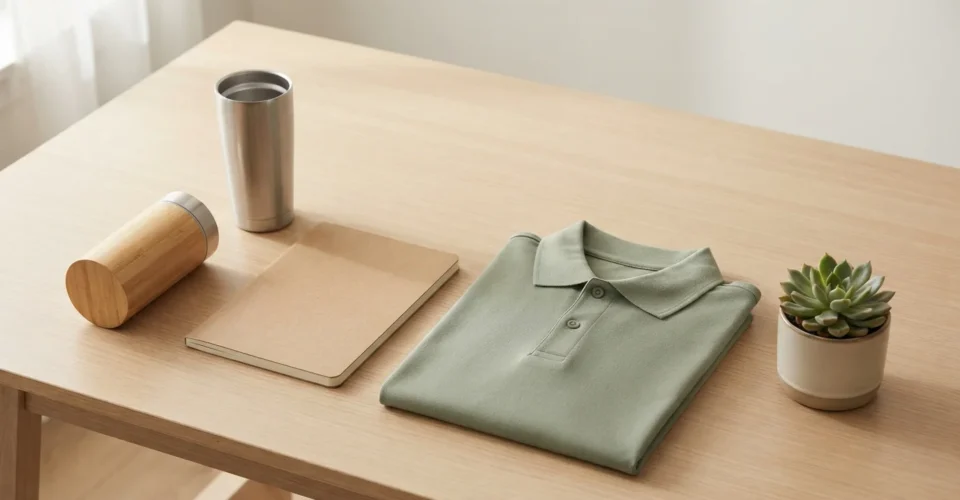
Bamboo and natural-fiber items — bamboo is fast-growing, biodegradable, and requires no pesticides, making it a popular material for tech accessories such as wireless chargers, power banks, and desk organizers.
Recycled materials — notebooks made from recycled paper, bags made from recycled PET (often sourced from plastic bottles), and pens made from recycled plastic or cardboard all reduce the demand for virgin material.
Reusable drinkware — branded tumblers, water bottles, and coffee cups reduce single-use plastic consumption and tend to get daily use, which means far more brand exposure per item than a one-time-use giveaway.
Organic and sustainable textiles — organic cotton polo shirts, tote bags, and caps avoid the heavy pesticide and water use associated with conventional cotton farming.
Seed paper and biodegradable packaging — business cards or greeting cards embedded with seeds that recipients can plant, along with compostable packaging for gift sets, add a memorable, talkable element to a campaign.
A useful test before ordering: ask whether the item will still be in active use six months from now, and whether its materials break down responsibly at end of life. If the honest answer to either is no, it’s worth reconsidering the item, however well-branded it looks.
The Business Case: Beyond Just “Doing the Right Thing”
Choosing sustainable promotional products isn’t purely a values decision — there’s a practical upside for the business giving them.
Higher perceived value. Eco-friendly items, particularly bamboo tech accessories and quality drinkware, tend to read as more premium than generic plastic giveaways, even at a comparable cost per unit.
Longer product lifespan. Reusable and durable items get used repeatedly, which means the branding on them is seen far more often than a disposable item that gets discarded after one use — improving the real cost-per-impression of the gift.
Differentiation at events and trade shows. At UAE trade shows and conferences, most booths still hand out standard plastic merchandise. A well-chosen sustainable item stands out simply by not looking like everything else on the table.
Stronger alignment with client sustainability policies. Many corporate clients in Dubai now have internal policies restricting single-use plastics in gifts they accept, particularly in banking, aviation, and government-adjacent sectors. Offering sustainable alternatives removes friction from the gifting process altogether.
How to Choose the Right Sustainable Promotional Gifts in Dubai for Your Business
A few practical questions can narrow down the right choice quickly:
- Who is the recipient? Senior clients tend to respond well to premium bamboo tech items or quality drinkware; large employee or event audiences are often better served by cost-effective items like recycled notebooks or tote bags that still see daily use.
- What’s the occasion? UAE National Day, Ramadan and Eid, year-end appreciation gifts, and product launches each carry different expectations around presentation and packaging — sustainable packaging matters as much as the item itself here.
- How will it be branded? Confirm the branding method (laser engraving, screen printing, embroidery) works cleanly on the chosen material — bamboo and natural fibers can behave differently from plastic or metal during printing.
- What’s the realistic budget per unit at your required quantity? Sustainable materials have come down in price significantly over the past few years, and at bulk quantities many eco-friendly options are now cost-competitive with conventional alternatives.
For teams exploring options, it’s worth browsing a dedicated range of eco-friendly promotional products rather than treating sustainability as an afterthought bolted onto a standard catalogue — the material, durability, and branding considerations are different enough that a purpose-built selection tends to perform better.
Frequently Asked Questions
Are eco-friendly corporate gifts more expensive than conventional ones? Not necessarily. While some premium sustainable materials carry a modest cost premium, many bamboo, recycled, and reusable items are now priced comparably to standard promotional products, especially at bulk order quantities.
Can eco-friendly promotional products still be branded with a company logo? Yes. Bamboo, recycled plastics, natural fibers, and metal all accept standard branding techniques including laser engraving, screen printing, embroidery, and UV printing, though the best method depends on the specific material.
What are the most popular eco-friendly corporate gifts in the UAE right now? Bamboo wireless chargers and power banks, reusable stainless steel tumblers and water bottles, recycled-material notebooks, and organic cotton apparel are currently the most requested categories among Dubai businesses.
Do sustainable gifts help with government tender or procurement scoring in the UAE? Many UAE government and semi-government entities now include sustainability criteria in vendor and procurement evaluations, so demonstrable use of eco-friendly promotional materials can support compliance in this area, though specific requirements vary by entity.
The Takeaway
Sustainable promotional gifts in Dubai have moved from a nice-to-have to a genuine differentiator, driven by national policy, client expectations, and simple economics. Businesses that treat eco-friendly promotional products as a strategic category — rather than a token green item added to an order — tend to get more brand mileage and a stronger reception from clients and employees alike.